TIMING
Ears track low notes
In a 2014 PNAS study, brain responses were stronger to timing slips in the lower of two tones, and people's tapping followed the low part more.
See the study doodlebass
WHAT THE RESEARCH SAYS
The bass is the quiet engine of a band.
LOW AND STEADY the groove starts here
11.8% more Extra movement with very low bass on
A four-string bass reaches down to about 41 vibrations a second. Research suggests our ears and bodies lock on to low notes for timing, which may be why bass lines so often carry the beat.
THE SHORT ANSWER
Bass lines can look simple on paper.
Research suggests low notes help us find the beat.
TIMING
In a 2014 PNAS study, brain responses were stronger to timing slips in the lower of two tones, and people's tapping followed the low part more.
See the studyFEEL
At a live concert, people danced 11.8 per cent more when very low bass speakers were switched on, even though the sound was too low to detect.
See the numbersRANGE
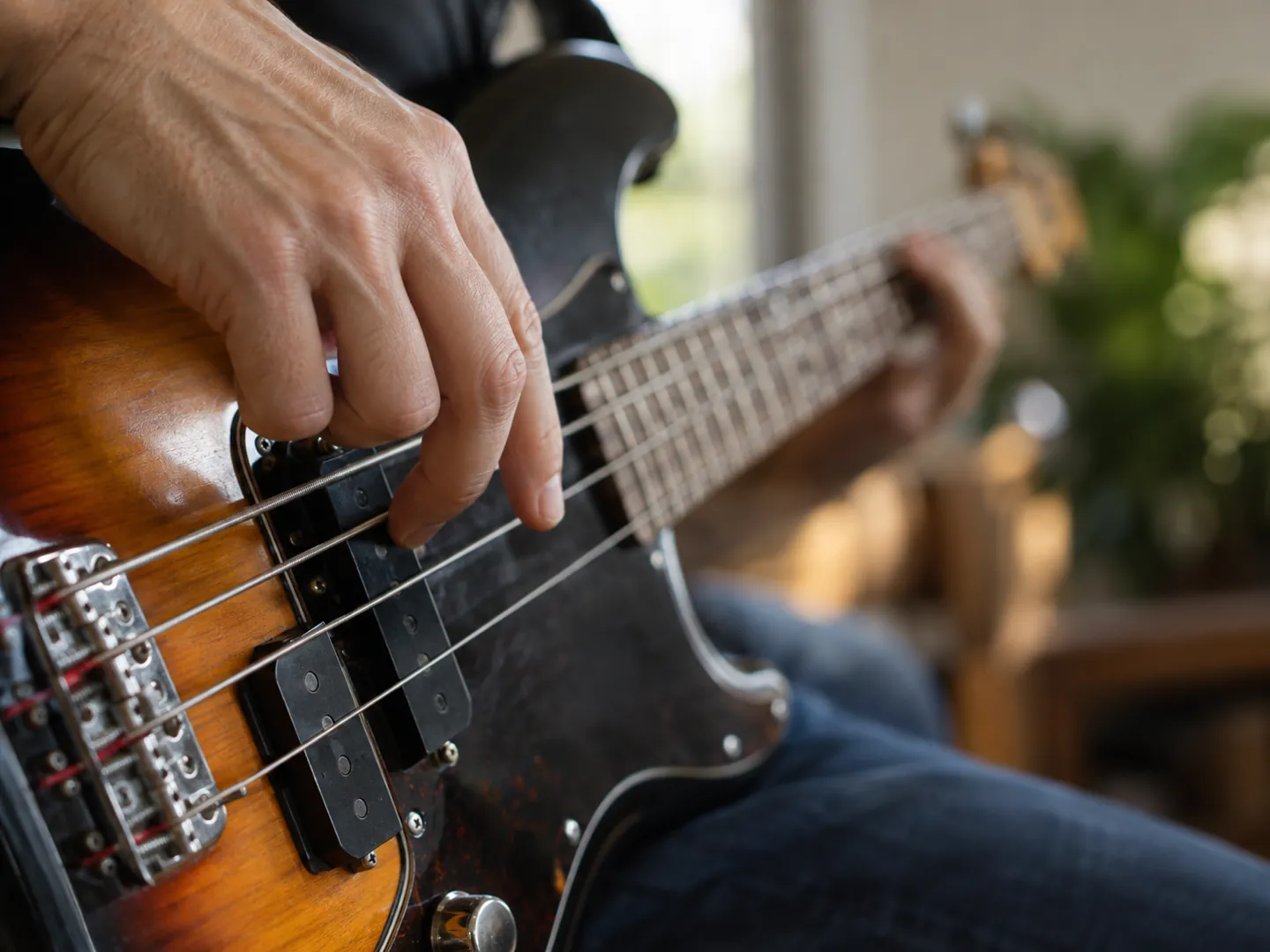
A standard bass is tuned E, A, D and G, an octave below a guitar's lowest four strings. A five-string adds a low B near 31 Hz.
Check a stringA QUICK STRING CHECK
Pick an open string to see how many times a second it vibrates. The bar shows how close it sits to the bottom edge of human hearing, about 20 Hz.
Frequencies are for standard tuning with the A above middle C at 440 Hz. One hertz (Hz) is one vibration per second.
FOUR WAYS TO BEGIN
Trinity College London's Rock & Pop bass syllabus shows what the first level of playing looks like. It is a useful map even if you never take an exam.

In Trinity exams players are responsible for tuning. Help is allowed up to Grade 5, so it is a skill to learn early.
Songs at Trinity's first level, Initial, last 45 seconds to 2 minutes and use mainly crotchet-based lines or repeated patterns.
Most Initial songs stay within an octave, often in keys that suit open strings, such as A major.
Exam songs are played with backing tracks, and synchronisation with the track is one of the things assessed.
TWO NUMBERS WORTH KNOWING
One figure from a concert experiment,
one on how low the instrument reaches.
11.8% more
Extra movement with very low bass on
During a 45-minute concert in McMaster's LIVELab, very low bass speakers were switched on and off every two minutes. Motion-sensing headbands showed people moved more when they were on. The results were published in Current Biology in 2022.
DANCING · McMASTER UNIVERSITY
≈ 41 Hz
Lowest open string of a four-string bass
The low E string, E1, vibrates about 41.2 times a second. Human hearing runs from approximately 20 to 20,000 Hz, so the bass works near the bottom of what we can hear.
RANGE · STANDARD TUNING
A 2014 study in PNAS by McMaster University researchers found that timing changes were picked up better in a lower tone than a higher one, in both brain recordings and tapping. Modelling suggested the inner ear itself contributes.
SMALL SPEAKERS
A musical note is made of a lowest frequency, the fundamental, plus higher harmonics. Even when the fundamental is missing, the brain can still work out the pitch from the harmonics that remain.
Simon Fraser University's acoustics handbook gives the example of a low voice heard through a telephone's carbon microphone. This effect is called the missing fundamental, or periodicity pitch.
Questions
Usually four, tuned E, A, D and G, the same as a double bass. Five-string basses add a low B, and six-string basses usually add a high C as well.
The low E string of a four-string bass vibrates at about 41.2 Hz. The low B of a five-string is about 30.9 Hz. Human hearing reaches down to approximately 20 Hz.
A 2014 PNAS study found people detected timing changes better in a lower tone than a higher one, and their tapping followed the lower part more. The authors suggest this helps explain why bass instruments often lay down the rhythm.
In a McMaster University concert study published in 2022, people danced 11.8 per cent more when very low bass speakers were on, even though surveys checked the sound was undetectable.
Yes. Trinity College London offers Rock & Pop bass exams from Initial through Grades 1 to 8. An electric bass must be used, and fretless or five-string basses are allowed.
Updated
ABOUT THIS NAME
doodlebass.com is part of the DoodleSale portfolio. It isn't in an auction right now, but you can ask about leasing it.